


PT6A Hot Section Inspection: When It’s Due, What It Finds, and What Deferring Really Costs
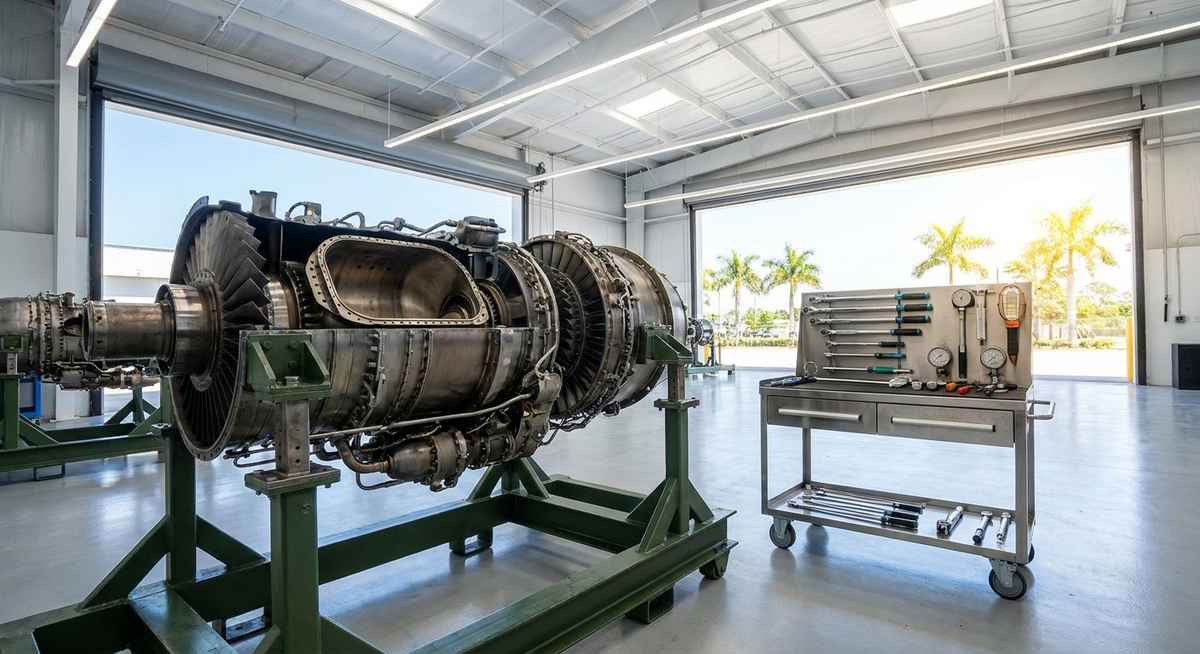
The hot section inspection is the single most consequential scheduled maintenance event in a PT6A’s life between overhauls. Done on schedule and done properly, an HSI is a mid-life checkup that keeps an engine on its intended overhaul interval. Deferred, rushed, or performed by a shop without deep PT6A experience, it becomes the reason a $200,000 overhaul turns into something considerably worse.
Here is a practical guide for operators, fleet managers, and directors of maintenance evaluating an upcoming HSI in 2026.
What the Hot Section Actually Is
The PT6A is a free-turbine, reverse-flow engine. Air enters at the rear, moves forward through the compressor, and reverses direction into the combustion chamber before driving the compressor turbine and then the independent power turbine. The “hot section” is the part of that path living in the harshest environment: the combustion chamber liner, the compressor turbine vane ring, the compressor turbine disc and blades, and the associated seals and hardware.
Everything in there operates at temperatures and rotational speeds that consume material over time. Blades creep and stretch. Vane rings erode and crack. Liners distort and burn through. None of this is a defect — it is the designed cost of extracting power from combustion, and the HSI exists to measure how much of that cost has been paid so far.
When Is an HSI Due?
There is no single number, and any shop that gives you one without asking questions is guessing. The interval depends on:
Engine model. PT6A variants differ substantially. Published time between overhaul figures across the PT6A family generally run from roughly 3,600 to 5,000 hours, with newer condition-monitored variants extending further. HSI intervals are typically set at a fraction of TBO — commonly in the 1,800 to 2,500 hour range, but model-specific.
Applicable service information. The governing documents are the engine maintenance manual and the current service bulletins and service information letters from Pratt & Whitney Canada, plus any applicable FAA airworthiness directives. Intervals and required inspection content change. What was correct for your engine three years ago may not be current.
Operating environment and mission profile. This is the part operators most often underestimate. A PT6A flying short-leg cargo or medevac work in a coastal, high-cycle environment accumulates hot section distress far faster per hour than a corporate turboprop flying long legs from an inland base. Cycles matter more than hours for turbine hardware. Salt-laden air matters more than either.
Trend monitoring data. If you are logging ITT, torque, Ng, and fuel flow properly, the trend tells you what the calendar cannot. A gradually rising ITT at a given power setting is the engine telling you the hot section is deteriorating before any inspection is due.
For your specific serial number and configuration, our turbine engine service team reviews the maintenance manual, applicable service bulletins, and your actual operating history together rather than quoting an interval from memory.
What an HSI Actually Involves
An HSI is not a bore-and-look. A proper hot section inspection on a PT6A means separating the engine at the gas generator case, removing the power section, and physically inspecting, measuring, and evaluating:
- Combustion chamber liner — cracking, distortion, burn-through, coating loss, cooling hole condition
- Compressor turbine vane ring — erosion, cracking, bow, throat area measurement
- Compressor turbine disc and blades — creep, stretch, tip condition, cracking, blade-to-shroud clearance
- Fuel nozzles — flow test, spray pattern, coking
- Seals, shrouds, and interstage hardware — wear and clearance measurement
- Accessory and gearbox condition — as accessible during the disassembly
The evaluation is where experience shows. Many findings sit in a judgment band — a vane ring measurement inside limits but trending toward them, a blade at the edge of stretch tolerance. A shop that has done thousands of PT6A hot sections knows which of those will still be serviceable in 900 hours and which will strand you. A shop that mostly works other engine types does not.
The Case for Doing It Slightly Early
Operators naturally want to run every available hour before opening an engine. Sometimes that is correct. Often it is not, and here is why.
Hot section hardware fails progressively. A vane ring that erodes past limits stops directing gas flow correctly, which raises ITT, which accelerates distress on the turbine blades downstream, which raises temperatures further. That feedback loop is the mechanism by which a deferred HSI turns into a hot section that has damaged the compressor turbine disc — and disc replacement is an order of magnitude more expensive than the vane ring you could have caught.
The economics are usually straightforward. The incremental cost of doing an HSI 150 hours early is a fraction of the cost of replacing a life-limited rotating component that failed because you waited. If your trend data is rising, treat that as the interval, not the manual’s number.
A borescope inspection is the low-cost way to make this decision with evidence rather than instinct. A video borescope of the combustion liner and turbine hardware costs a small fraction of an HSI and tells you whether you are looking at a routine event or a problem developing.
What Drives HSI Cost
The disassembly labor is largely fixed. The variance is in findings.
A clean HSI on a well-operated engine — liner serviceable, vane ring within limits, blades good, nozzles cleaned and flow-tested — is at the low end. An HSI that finds a distorted liner, an out-of-limits vane ring, and blades requiring replacement climbs quickly. Disc findings change the conversation entirely.
Two things reduce your exposure meaningfully:
Parts strategy. Overhauled and serviceable hot section components, plus FAA-PMA parts where approved and appropriate, can substantially reduce the parts bill without compromising airworthiness. We stock PT6 parts and are an authorized distributor for Southwest Turbine and Extex Engineered Products, which shortens both cost and lead time on common findings.
Consistent preventive practice. Compressor washes on schedule, correct engine rigging, attentive trend monitoring, and prompt investigation of anomalies show up directly in HSI findings. Engines that were operated carefully cost less to inspect.
Regulatory Framework
Whatever your maintenance plan, it has to align with the approved data. The Federal Aviation Administration governs required inspections, airworthiness directives, and the return-to-service documentation that follows an HSI. Work must be performed and signed off under appropriate certification, and the records need to support the engine’s continued airworthiness — including for the resale or lease value of the asset, where a well-documented HSI history is worth real money.
Planning the Downtime
The other cost of an HSI is aircraft unavailability. Reduce it by:
- Scheduling into your slowest season rather than reacting to a due date
- Confirming parts availability before induction, not after teardown
- Pre-approving a findings threshold so the shop can proceed without waiting on a decision
- Using engine management to budget and schedule the event years ahead rather than absorbing it as a surprise
For operators who cannot bring the aircraft to a shop, our field repair teams deploy globally, typically within 48 hours.
Talk to a PT6A Specialist About Your Next HSI
We have worked on PT6A engines exclusively as a core specialty since 1981, in English and Spanish, for operators across the Americas. If you have an HSI coming due — or trend data you do not like — a short conversation now is cheaper than a surprise later.
Contact JetSet Airmotive for an HSI evaluation
JetSet Airmotive — 6065 NW 167th St #B21, Hialeah, FL 33015 — https://www.jsamiami.com